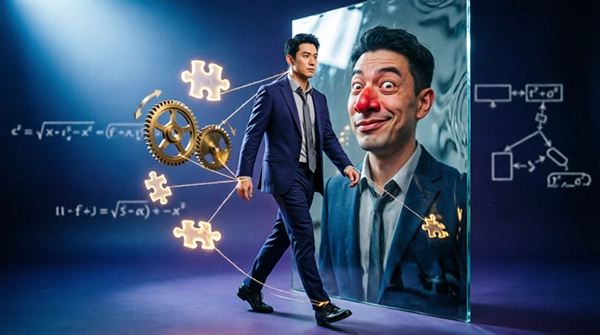
Why Smart People Make Bad Decisions
You know someone like this. Maybe you are someone like this. A person who can analyze a complex problem at work with surgical precision, who can spot the flaw in an argument from across the room, who can read a balance sheet or a legal brief or a medical scan and see what everyone else missed. And then this same person makes a decision about their own life that is so obviously wrong that everyone around them wonders what happened.
A 2023 analysis from The Hock Group put it bluntly: intelligence increases the ability to fool yourself with elaborate stories about why something happened. The smarter you are, the better you are at constructing a narrative that makes your bad decision look reasonable. The better you are at finding evidence that supports what you already want to believe. The better you are at ignoring the evidence that does not.
This is not a character flaw. It is not a failure of willpower. It is a feature of how the human brain works when it is under the influence of four specific cognitive states. The research on this is extensive, and it points to something uncomfortable: the same intelligence that makes you effective in one domain can make you blind in another.
Emotional Dependence: The Bias That Blinds You to the Truth
The first bias is emotional dependence. Not love. Not attachment. Dependence. There is a difference.
A 2026 study published in Psychological Reports examined the relationship between emotional dependence and cognitive distortions. The findings were specific. Higher emotional dependence was correlated with systematic distortions in thinking. Not random errors. Stable patterns. The researchers identified a cognitive schema they called “threat-ought-helplessness” that characterized dependent individuals: they experienced the world as threatening, believed they should be able to control it, and felt helpless when they could not.
The practical translation is this. When you are emotionally dependent on someone, you cannot see them clearly. Your perception is filtered through your need. You see what you need to see, not what is actually there. A mother who cannot admit her son has a problem. A spouse who cannot see the signs of infidelity. A parent who excuses behavior that would horrify them in anyone else’s child.
The research on attachment bias supports this. A 2025 study in the Journal of Cognitive Psychology found that attachment avoidance predicted attentional disengagement from emotional stimuli, while attachment anxiety predicted attentional vigilance. The anxiously attached are hypervigilant to threat. The avoidantly attached are blind to it. Both are distortions. Both are defenses.
The way out is not to stop loving. It is to recognize the difference between loving someone and needing them. The research on cognitive behavioral therapy shows that when people learn to identify the distortions—the “should” statements, the catastrophizing, the emotional reasoning—they can begin to see past them. A therapist can help you separate what you feel from what is true. That is not a sign of weakness. It is a sign of wisdom.
Scarcity Mindset: How Lack Hijacks Your Brain
The second bias is scarcity. When you feel like you do not have enough of something—money, time, love, attention—your brain changes how it processes the world.
A 2025 study in ScienceDirect examined the scarcity mindset in the context of financial decision-making. The researchers described a “bandwidth tax” that scarcity imposes on mental capacity. The experience of not having enough creates a hyperfocus on the scarce resource. This can be adaptive in the short term. It helps you solve the immediate problem. But it comes at a cost. It makes you less able to see the bigger picture. It makes you less able to prioritize future opportunities. It makes you less able to make decisions that are in your long-term interest.
A 2019 study published in PNAS used neuroimaging to examine what happens in the brain under scarcity. The researchers induced a scarcity mindset in participants and then measured their neural processing during decision-making. The finding was that scarcity altered the neural mechanisms underlying goal-directed decision-making. The effects were largest when the current situation was compared to previous situations of abundance.
The practical translation is this. When you are starving for something, you cannot think clearly about it. A man who grew up poor and is now wealthy may still make financial decisions based on the fear of poverty. A woman who was emotionally neglected as a child may choose partners based on the hunger for attention, not the reality of the relationship. The scarcity is not in the present. It is in the mind. But the mind cannot tell the difference.
Fear Bias: When Anxiety Distorts Your Decisions
The third bias is fear. Not the fear of a real, immediate threat. The fear that lives in the background. The anxiety that colors everything.
A 2026 study published in the Journal of Psychopathology and Clinical Science examined judgmental and attentional biases in anxiety. The researchers had participants with anxiety disorders and healthy controls complete an emotion ensemble judgment task. The anxiety group made more fearful judgments than the control group. And here is the paradox: the eye-tracking data showed that the anxiety group paid more attention to happy stimuli than fearful stimuli. They were avoiding the threat. But they were still judging the situation as more threatening.
This is the mechanism of fear bias. The anxious brain avoids the thing it fears, but it cannot stop the fear from distorting its judgments. The avoidance does not work. It just makes the fear stronger.
A 2020 article from the Association for Psychological Science described the work of decision scientist Jennifer Lerner, who showed that feeling fear led people to believe that anxiety-provoking possibilities were more likely to occur. The fear did not make the threat more real. It just made it feel more real.
The practical translation is this. When you are afraid, you cannot accurately assess risk. You overestimate the likelihood of the thing you fear and underestimate your ability to handle it. The fear is not a guide. It is a filter. And the filter is distorting everything.
Defensiveness: The Cognitive Wall You Cannot See
The fourth bias is defensiveness. The need to be right. The need to protect the ego. The need to win.
A 2005 study in ScienceDirect examined the relationship between defensiveness and cognitive bias. The researchers found that defensiveness was associated with a decrease in processing of masked threat words. In plain language: defensive people literally did not process threatening information. Their brains were filtering it out before it reached conscious awareness.
A 2020 study published in the British Journal of Social Psychology found that defensiveness in response to wrongdoing was exacerbated by making the person feel like an outcast. The defensive posture was not about the facts. It was about belonging. It was about protecting the self from the threat of rejection.
The practical translation is this. When you are defensive, you cannot hear criticism. You cannot see your own mistakes. You cannot learn. The defensiveness is not a sign of strength. It is a sign of fragility. The person who cannot admit they are wrong is the person who cannot grow.
What the Research Actually Says About Breaking These Patterns
The research on cognitive bias is clear. These patterns are not fixed. They are not character traits. They are mental habits. And habits can be changed.
The first step is recognition. You cannot change what you cannot see. The research on cognitive behavioral therapy shows that when people learn to identify their distortions, they can begin to challenge them. A therapist can help you see the patterns you cannot see on your own.
The second step is exposure. The research on fear and avoidance shows that the only way to reduce fear is to face it. Not all at once. Gradually. In small doses. The fear shrinks when you stop feeding it.
The third step is self-compassion. The research on self-criticism shows that beating yourself up for your biases does not make them go away. It makes them worse. The people who improve are the ones who can acknowledge their patterns without hating themselves for having them.
If you are struggling with persistent anxiety, depression, or trauma, the research is clear. Professional support helps. A therapist can help you separate the normal biases of being human from something that requires treatment. That is not weakness. That is wisdom.
The Illusion of Objectivity
The most dangerous bias is the belief that you are not biased. The most dangerous illusion is the illusion of objectivity.
The surgeon who cannot see his son’s addiction. The CEO who cannot see the flaw in her strategy. The parent who cannot see the damage they are causing. None of them believe they are biased. They believe they are seeing clearly. They believe everyone else is wrong.
The research says otherwise. The research says that the human brain is a prediction machine. It sees what it expects to see. It filters out what it does not want to know. And the smarter you are, the better you are at constructing a story that makes your blindness look like insight.
The only way out is to accept that you might be wrong. To find someone who will tell you the truth. To be willing to listen. That is not a sign of weakness. It is the beginning of wisdom.