The Architecture of Righteousness: Why We Need to Stop Weaponizing Our Values
We have all felt that sudden, sharp tightening in the chest during an online debate or a family dinner. It is the moment a conversation stops being an exchange of ideas and quietly transforms into a quiet competition for moral territory. You do not just want to be right; you want the other person to feel the heavy, humbling weight of your correctness. But beneath that impulse lies an uncomfortable truth: when our deepest convictions become weapons to prove our superiority, we stop building a better world and start building a monument to our own ego.
The Performance of Purity
Consider the late-night doomscrolling session where a stranger’s flawed political take triggers an immediate, righteous fury. We craft a biting response, not out of a genuine desire to educate, but for the invisible nod of approval from our ideological peers. We signal our virtue to the crowd by publicly shrinking the person across the aisle.
In everyday life, this dynamic quietly poisons our most intimate connections. We correct friends with a little too much satisfaction, or dismantle a coworker’s perspective with clinical precision, secretly keeping score of who holds the moral high ground.
Psychologist Joshua Grubbs terms this underlying driver Status-Driven Righteousness—a behavioral loop where moral and political posturing serves as a proxy for social dominance. In his extensive research spanning over 6,000 participants, Grubbs found that individuals scoring high in moral superiority frequently display heightened narcissistic traits and view social status as their primary psychological currency. They are statistically far more likely to generate daily friction, burn bridges with friends over ideological differences, and weaponize public platforms to shame dissenters.
“We sometimes inflict cruelty on our ideological opponents not to change their minds, but to secure the applause and validation of our own tribe.”
The Echo Chamber Trap
Why does this happen so easily? Because modern systems are engineered to reward polarization. Political extremism and social media algorithms rely on the same psychological fuel: the creation of a clear, undeniable enemy. When we label the “other side” as fundamentally corrupt rather than merely mistaken, our brains experience a comforting surge of certainty.
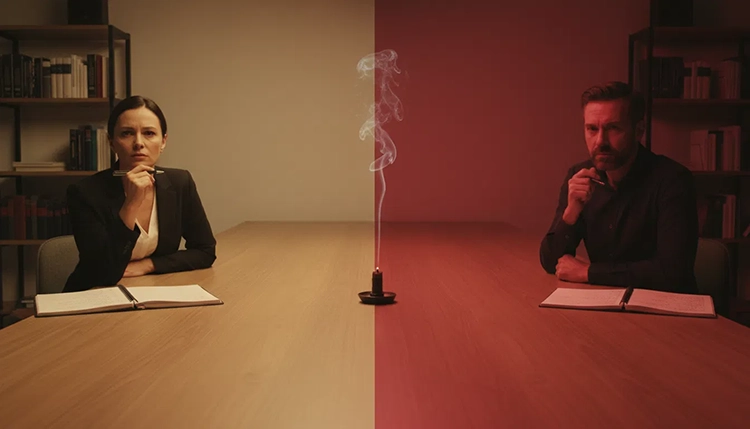
Imagine two political echo chambers shouting across a widening canyon. Neither side is listening, because listening requires vulnerability, whereas shouting requires only armor. Over time, this constant cultural friction turns everyday public discourse into a toxic gas. Breathing becomes difficult not because the air lacks oxygen, but because it is thick with hostility.
Yet, beneath our anger lies a quiet exhaustion. We are tired of fighting, tired of performing, and tired of the endless friction.
Breaking the Cycle of Superiority
To heal this divide, we must dismantle the Righteousness Reflex—that automatic, ego-protective urge to dominate every ideological disagreement. This requires stepping away from the digital pulpit and returning to the messy, vulnerable work of human connection.
- The Pause Before the Post: Before entering an argument, ask yourself a quiet, destabilizing question: Am I trying to build a bridge, or am I trying to plant a flag on their dignity?
- The Radical Assumption of Equality: Remind yourself that the person holding the opposing view operates from the exact same internal conviction that they are fighting for goodness and safety.
Real progress does not arrive when the loudest voice wins the room. It arrives in the quiet, unglamorous moments when we look across our differences and remember that no human being is ever less human than ourselves. Another way of living together is entirely possible—it simply begins the moment we put down our weapons.
The Two-Minute Experiment
Later today, when a conversation touches on a topic where you strongly disagree with someone, pause before offering your view. Instead of arguing or correcting, ask one genuine, non-judgmental question: “What makes you feel that way?” Listen to their answer completely, without planning your rebuttal. Notice how the entire emotional temperature of the room shifts the moment you trade the desire to be superior for the desire to understand.