The Architecture of Stillness: Why Doing Nothing is the Ultimate Strategic Advantage
We live inside an engine of relentless acceleration. With a single tap on a screen, food arrives at our door, cross-continental conversations happen in real-time, and loans are approved before we have even finished our morning coffee. We have engineered a world that completely eliminates friction—and in doing so, we have accidentally starved our minds of their most vital nutritional requirement: the capacity to wait.
The Tyranny of the Immediate
Consider the late-night professional crisis where an unexpected career disruption or life upheaval leaves tomorrow looking entirely blank. The instinctual panic arrives instantly. The mind begins spinning frantic scenarios, whispering that any action—no matter how reckless—is inherently better than the agonizing discomfort of sitting still.
In everyday life, this manifests as the hurried text message sent out of anxiety, the premature decision made simply to quiet the nervous system, or the endless mental chewing on a problem that cannot yet be solved.
We act this way because the human brain despises a vacuum. Neuroscience reveals that the brain treats uncertainty and the unknown as an existential threat, triggering the same neural alarm bells as physical danger. Your ego joins the chorus, demanding control, convinced that if you stop moving forward at breakneck speed, you will surely vanish.
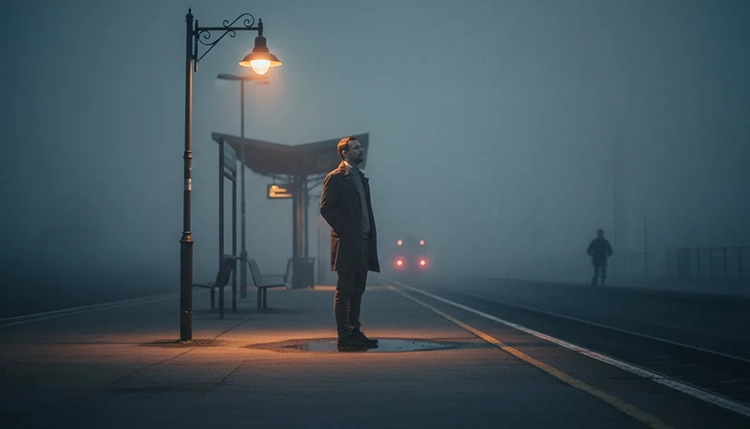
“The mind and the ego demand a brightly lit, perfectly smooth superhighway to the future, whereas real life is experienced more like a fog-filled labyrinth.”
The Intelligence of the Pause
Why do our fastest decisions so frequently lead to our deepest regrets? Because speed is the enemy of integration. When we rush to resolve a dilemma, we rely purely on immediate reactivity rather than deep, synthesized intelligence.
Imagine two drivers navigating a pitch-black mountain road. The one who floors the accelerator out of panic will inevitably crash into the first hidden curve. But the driver who pulls over, cuts the headlights, and simply sits in the dark experiences a profound neurological shift: the pupils dilate, the shapes of the landscape begin to emerge from the shadows, and the correct path reveals itself naturally.
This is the hidden mechanics of what we might call Strategic Latency—the deliberate art of allowing a situation to settle before attempting to steer it. When we stop thrashing against uncertainty, an unexpected internal resource activates.
Harnessing the Power of the Wait
To master the art of waiting, we must reframe it not as passive helplessness, but as active psychological distillation. Waiting creates the necessary mental runway for three critical shifts:
- Cognitive Decompression: It pulls you out of emotional flooding, giving your prefrontal cortex time to come back online and override the panic centers of the brain.
- Pattern Recognition: It allows you to scan past experiences, remembering what worked—and what failed—during previous seasons of ambiguity.
- The Internal Answer: Most of the time, the deep-seated answer to the question keeping you awake is already resting quietly inside you, buried beneath the static of your anxiety.
As the ancient text I Ching observes, waiting is never merely empty hope; it is the quiet, internal certainty of arrival.
The Two-Minute Experiment
Later today, when you encounter a sudden stressor or an unanswered question that makes your chest tighten, resist the urge to immediately fix, solve, or text. Instead, set a timer for two minutes. Close your eyes, drop your shoulders away from your ears, and ask yourself a single question: “What happens if I simply allow this to remain unresolved for right now?” Notice how the frantic internal noise begins to quiet the moment you give your mind permission to rest in the unknown.