The Decision You Are Avoiding Is Already Costing You
The decision is not waiting for you to feel ready. It is waiting for you to stop pretending that waiting is free. Every day you do not choose, you are choosing the status quo, and the status quo has a price. The price is paid in sleep, in resentment, in the slow erosion of self-trust. The research on decision-making has a name for this pattern. I call it decisional inertia: the tendency to remain in a familiar state even when the cost of remaining exceeds the cost of changing. The inertia is not laziness. It is a physiological response to uncertainty, and it can be interrupted.
The kitchen table in Austin
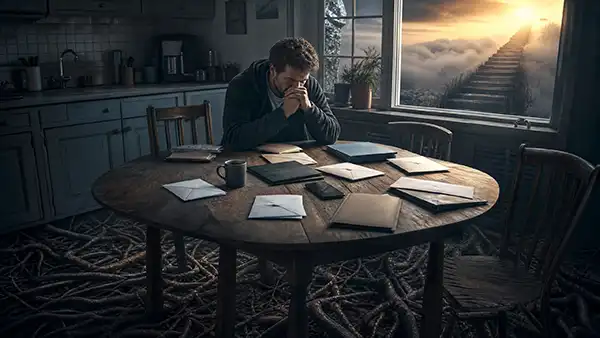
The man at the kitchen table was forty-one. He had been offered a job in Denver. The salary was higher. The work was more interesting. His wife had already said she would go. His children were young enough to adapt. The decision should have been easy. It was not. He had been sitting at the table for three weeks, not deciding. He went to work. He came home. He ate dinner. He opened his laptop. He looked at the offer letter. He closed the laptop. He told himself he would decide tomorrow. Tomorrow became next week. Next week became next month. The offer expired on a Friday. He did not call. He told himself it was not the right time. He told himself there would be other offers. There were not. Not like that one.
What he did not know was that the decision had already been made. It had been made by the part of his brain that treats uncertainty as a threat. The part that prefers the known pain to the unknown possibility. The part that does not care about his career or his happiness. It only cares about survival. And survival, in the ancient sense, meant staying with the familiar. The familiar was safe. The unfamiliar was dangerous. The offer letter was unfamiliar. So the brain rejected it without his conscious consent.
Why hesitation is biological
The brain does not process a decision the way a spreadsheet processes data. It processes it the way an animal processes a fork in the trail. One path is known. One path is unknown. The known path has a predictable outcome. The unknown path has an unpredictable outcome. The brain is biased toward the predictable. This bias is not a flaw. It is an evolutionary adaptation. The ancestors who preferred the known path were more likely to survive. The ancestors who preferred the unknown path were more likely to be eaten. The bias is in your genes.
The research on status quo bias, first documented by William Samuelson and Richard Zeckhauser in 1988, has shown that people disproportionately prefer the current state of affairs. When given a choice between keeping what they have and switching to something potentially better, they keep what they have. The preference is not rational. It is automatic. A 2025 study published in the Journal of Economic Psychology examined status quo bias across twenty countries and found that the bias was stronger in cultures with higher uncertainty avoidance. The bias is not just individual. It is cultural.
The brain also treats the possibility of loss differently from the possibility of gain. Daniel Kahneman and Amos Tversky demonstrated this in their work on prospect theory. Losses loom larger than gains. The pain of losing something is roughly twice as powerful as the pleasure of gaining something of equal value. The offer in Denver had a potential gain: more money, more interest, a new city. But it also had a potential loss: the known routine, the familiar faces, the identity that had been built around the current job. The loss was vivid. The gain was abstract. The brain chose the loss. It chose to avoid the pain of losing the known. It did not weigh the pain of losing the opportunity. The opportunity was not yet real. The known was real.
What the research says about regret
The man at the kitchen table believed he was avoiding regret. He was actually choosing a different kind of regret. The research on regret has consistently found that people regret inactions more than actions in the long run. Thomas Gilovich and Victoria Medvec at Cornell University demonstrated this pattern in a series of studies. In the short term, people regret the mistakes they made. In the long term, they regret the chances they did not take. The job they did not apply for. The relationship they did not pursue. The move they did not make. The pattern is robust across cultures and age groups.
A 2025 study published in Emotion examined the relationship between decisional inertia and life satisfaction across 2,400 adults. The findings showed that participants who reported high levels of decisional inertia—the tendency to delay or avoid decisions—reported lower life satisfaction, higher anxiety, and higher levels of rumination. The rumination was the mechanism. The undecided decision did not disappear. It stayed in the mind, consuming attention, generating stress, and preventing the person from being present in the rest of their life. The decision that was not made became a full-time job.
The man at the kitchen table was not avoiding the decision. He was living inside it. The offer letter was on his laptop. The question was in his head. The question was there when he woke up. It was there when he ate lunch. It was there when he played with his children. It was there when he tried to sleep. The decision he was avoiding was costing him more than the decision he was afraid to make. The cost was invisible. But it was real.
The invisible cost of the unmade decision
The cost of the unmade decision is not a line item on a budget. It is not visible on a calendar. It is the background hum of anxiety that accompanies every other activity. The man at the kitchen table was not only failing to decide about Denver. He was failing to be present in Austin. The research on cognitive load has shown that unresolved decisions consume working memory resources. The mind does not file them away. It keeps them open, running in the background, draining capacity that could be used for other things. A 2024 study published in Journal of Experimental Psychology: General found that participants who were asked to postpone a decision performed worse on subsequent cognitive tasks than participants who were asked to make the decision immediately. The postponement was not neutral. It was a tax.
The tax is paid in attention. The person who is waiting to decide is not fully available to their family, their work, or their own life. They are divided. They are half-present. The other half is in the decision. The decision that has not been made. The decision that is always there. The decision that will not leave until it is addressed. The cost is invisible because it is not an event. It is a condition. It is the condition of being unavailable to your own life.
Choice overload and the paralysis of options
Barry Schwartz at Swarthmore College wrote a book called The Paradox of Choice. The central argument was that having more options does not make people happier. It makes them more anxious. The research on choice overload, conducted by Sheena Iyengar at Columbia University and Mark Lepper at Stanford, demonstrated the effect in a famous study of jam. Participants who were presented with twenty-four varieties of jam were less likely to purchase than participants who were presented with six. The abundance of options reduced motivation. The abundance of options increased regret. The person who chooses one jam from twenty-four will always wonder about the twenty-three they did not choose.
The man at the kitchen table had two options. Two is not twenty-four. But the dynamic was the same. He was not choosing between two jobs. He was choosing between two identities. The identity of the man who stayed. The identity of the man who left. Each identity had a cost. Each identity had a benefit. The choice was not about the job. It was about who he would become. The weight of the identity made the decision feel impossible.
The research on identity and decision-making has shown that decisions that threaten identity are processed differently from decisions that do not. A 2024 study published in Journal of Personality and Social Psychology examined the neural correlates of identity-relevant decisions. The findings showed that decisions that threatened the participant’s self-concept activated the amygdala and the insula—regions associated with threat and disgust—more strongly than decisions that did not. The brain treated the identity threat as a physical threat. The man was not being indecisive. He was being protective. He was protecting the self he had built.
A practice for making decisions you cannot undo
The way out of decisional inertia is not more thinking. It is a structured practice. The practice has three steps. The first step is to name the cost of not deciding. Not the cost of the decision. The cost of the waiting. The sleep lost. The attention consumed. The resentment accumulated. The opportunities missed. The cost is usually higher than the person realizes. The naming makes it visible. Write it down. The writing is not a formality. It is a mechanism. The research on expressive writing, developed by James Pennebaker at the University of Texas at Austin, has shown that putting difficult experiences into words produces measurable improvements in health and well-being. The writing organizes the chaos. The organization reduces the load. The reduction creates space for the decision.
The second step is to separate the decision from the identity. The decision is not who you are. It is what you do. The man at the kitchen table was not choosing between being a good father and being a bad father. He was choosing between two cities. The identity was a story he was telling. The story was making the decision feel like a verdict on his worth. The story had to be set aside. The decision had to be reduced to its actual components: the salary, the work, the schools, the commute, the weather. The components were manageable. The identity was not.
The third step is to set a deadline and commit. The research on implementation intentions, developed by Peter Gollwitzer at New York University, has shown that people who specify when, where, and how they will act are significantly more likely to follow through. The deadline is not arbitrary. It is a structure. The structure prevents the decision from expanding to fill all available time. The man at the kitchen table did not set a deadline. The offer expired on its own. The deadline was imposed by someone else. The imposition was the decision. He did not make it. It was made for him.
When the paralysis is clinical
There is a difference between the ordinary difficulty of making a hard decision and the chronic paralysis that characterizes certain mental health conditions. The research on generalized anxiety disorder, major depression, and obsessive-compulsive disorder has shown that indecision is often a symptom, not a cause. The person who cannot decide what to eat for lunch may be experiencing a clinical condition that requires professional assessment. The person who cannot decide whether to end a relationship may be experiencing the same. A 2025 study published in Journal of Anxiety Disorders found that participants with generalized anxiety disorder reported significantly higher levels of decisional procrastination than healthy controls. The indecision was not a personality trait. It was a symptom. It was treatable.
If the inability to decide is persistent, if it interferes with sleep, appetite, work, or relationships, if the anxiety surrounding the decision is producing physical symptoms that are difficult to manage, the appropriate response is not to try harder to decide. It is to speak with a mental health professional who can assess what is happening and recommend an appropriate course of care. The research on cognitive behavioral therapy and other evidence-based treatments for anxiety and depression is robust. Support is not a sign that you have failed to be decisive. It is a recognition that some decisions are harder than others, and some people need help carrying the weight.
Life on the other side
The man at the kitchen table did not move to Denver. He stayed in Austin. He told himself he had made the right choice. He told himself the timing was wrong. He told himself there would be other offers. He was still telling himself these things five years later. He was still at the same job. He was still at the same table. The offer letter was gone. The question was not.
The question was not gone because the decision had never been made. The decision had been made by default. The default was the status quo. The status quo was the familiar. The familiar was safe. The safe was not the same as the satisfying. The research on life satisfaction has consistently found that the quality of a life is determined not by the absence of risk but by the presence of meaning. Meaning is not found in the familiar. Meaning is found in the chosen. The chosen requires the risk. The risk requires the decision. The decision requires the courage to act before the fear is gone.
The fear does not go away. The research on courage, conducted by Cynthia Pury at Clemson University, has shown that courage is not the absence of fear. It is the willingness to act despite the fear. The man at the kitchen table was waiting for the fear to go away. It did not go away. It grew. The waiting fed the fear. The waiting made the decision larger. The waiting made the status quo more comfortable. The comfort was the trap. The trap was the life. The life was the waiting.
Ending the waiting
The decision is not a single moment. It is a practice. The practice is the willingness to choose without certainty. The practice is the willingness to act without a guarantee. The practice is the willingness to disappoint the version of yourself that wanted to stay safe. The version of yourself that wanted to avoid the risk. The version of yourself that wanted to keep the familiar. The version of yourself that was not you. The version of yourself that was the fear.
The man at the kitchen table is still there. He is still waiting. The offer is gone. The decision is gone. The life he could have had is gone. The only thing that remains is the question. The question he never answered. The question he is still answering. The question he will answer for the rest of his life. The question is not whether he made the right choice. The question is whether he made a choice at all. The answer is no. The answer is the cost. The answer is the life.