The Vision Document That Nobody Read
The anthropologist arrives in the conference room at 9:15 a.m. The slide on the screen reads “Vision 2030: A Roadmap for Transformation.” The font is clean. The colors are blue and gray. The room is full of people who have been invited to listen. The presenter speaks for thirty-seven minutes. The words “strategy,” “vision,” “sustainable,” and “future” appear a combined forty-two times. At the end, there is applause. Then everyone returns to their desks and does exactly what they were doing before. The document is filed. The file is never opened again. The anthropologist takes notes.
A ritual performed in offices around the world
This is not a story about a bad strategy. The strategy may be excellent. The document may contain accurate data, thoughtful analysis, and actionable recommendations. The problem is not the quality of the thinking. The problem is the distance between the thinking and the doing. The research on this distance has a name. It is called the strategy-execution gap, and it is one of the most documented and least addressed problems in organizational life.
A 2025 global study conducted by the Project Management Institute surveyed more than 5,800 project professionals, executives, and knowledge workers. The findings were stark. Just half of projects meet a modern definition of success: delivering value that exceeds the effort and expense involved. Thirteen percent fail outright. Thirty-seven percent deliver only partial results. The top barrier to transformation, cited by 35 percent of executives, is not a lack of ideas, capital, or technology. It is the disconnect between planning and execution.
The anthropologist writes this down. The disconnect is not a bug in the system. It is a feature. The system has been designed to produce documents, not outcomes. The document is the product. The outcome is optional.
The 67 percent that nobody wants to discuss
Harvard Business Review has been cited so often on this point that the statistic has become a cliché. Approximately 67 percent of well-formulated strategies fail because of poor execution, not because the strategy itself was flawed. Robert Kaplan at Harvard Business School has suggested the number may be even higher, with up to 90 percent of organizations falling short in translating strategy into action.
The anthropologist is not surprised. The anthropologist has seen this pattern in every organization studied. The pattern is not about competence. The people in the room are competent. The pattern is about the absence of a mechanism that converts intention into behavior. The research on implementation intentions, developed by Peter Gollwitzer at New York University, has shown that people who specify when, where, and how they will act are significantly more likely to follow through than people who simply intend to act. The strategy document does not contain if-then plans. It contains aspirations. Aspirations are not instructions.
What the spreadsheet cannot measure
The second observation the anthropologist makes is about measurement. The strategy document is full of numbers. Market size. Growth rate. Projected revenue. These numbers are estimates. They are projections. They are not measurements of anything that has happened. The research on measurement in management has a long history. The management theorist Peter Drucker is often credited with the observation that what gets measured gets managed. The attribution is disputed, but the principle is not. The organizations that measure their progress are the ones that make progress. The organizations that measure only their intentions are the ones that produce documents.
The problem is not the absence of data. The problem is the absence of relevant data. A 2025 report from the Project Management Institute found that only 7 percent of professionals say they are consistently using the four elements that predict project success: managing perceptions, owning success beyond traditional metrics, relentlessly reassessing, and expanding perspective. When those four elements are applied, the net project success score jumps from 27 to 94. But almost no one applies them.
The anthropologist writes this down. The tools exist. The knowledge exists. The application does not. This is not a knowledge problem. It is a will problem. It is a habit problem. It is a problem of what happens after the meeting ends.
Why the amygdala prefers the status quo
The third observation is about biology. The human brain is not designed to execute strategies. It is designed to survive. The research on status quo bias, first documented by William Samuelson and Richard Zeckhauser, has shown that people disproportionately prefer the current state of affairs. When given a choice between keeping what they have and switching to something potentially better, they keep what they have. The preference is automatic. It is not rational. It is a survival mechanism that evolved in environments where the known was safer than the unknown.
The research on organizational inertia has documented the same pattern at the collective level. A 2025 study published in the Journal of Organizational Change Management examined the performance appraisal routines that sustain organizational stasis. The findings showed that the degree of managerial control and the feedback schemes applied were the main determinants behind resistance to change. The system was not failing to change. The system was succeeding at staying the same.
The anthropologist writes this down. The organization is not broken. The organization is doing exactly what it was designed to do. It was designed to maintain equilibrium. The strategy document was designed to disrupt equilibrium. The two designs are in conflict. The equilibrium wins.
The theater of strategy
This is where the anthropologist introduces a term. The term is strategic theater. Strategic theater is the production of strategy documents, vision statements, and transformation roadmaps that serve a performative function rather than an operational one. The document is not a plan. It is a signal. It signals to the board that leadership is thinking about the future. It signals to employees that change is coming. It signals to the market that the organization is forward-looking. The signal is the product. The execution is the afterthought.
The research on impression management has shown that organizations engage in symbolic actions that are designed to be seen rather than to be done. A 2024 study published in Academy of Management Review examined the relationship between strategic planning and organizational legitimacy. The findings suggested that planning activities often serve a legitimating function, demonstrating to stakeholders that the organization is rational, forward-looking, and well-managed, regardless of whether the plans are implemented.
The anthropologist does not judge this. The anthropologist observes. The theater is not a lie. It is a ritual. Rituals serve a purpose. They create cohesion. They signal values. They mark transitions. The problem is when the ritual becomes a substitute for the action it was meant to inspire. The problem is when the applause at the end of the presentation is mistaken for the sound of work being done.
The gap between planning and doing
The fourth observation is about the gap itself. The anthropologist has spent time in the space between the plan and the execution. This is where the strategy dies. The plan says “increase market share by 15 percent.” The execution requires someone to make fifty phone calls, redesign a product, renegotiate a contract, and train a sales team. The plan is one sentence. The execution is a thousand decisions. The plan is celebrated. The decisions are invisible.
The research on the intention-behavior gap has shown that the distance between knowing what to do and doing it is not a matter of motivation. It is a matter of structure. A 2025 study published in the Journal of Applied Psychology found that day-specific implementation intentions were positively related to day-specific behaviors. The participants who had a specific plan for when and where they would act were the ones who acted. The participants who had only a general intention did not.
The anthropologist writes this down. The strategy document is a general intention. It does not specify when, where, or how. It does not specify who is responsible. It does not specify what will be measured. It does not specify what will happen if the measurement is not met. It is a wish. Wishes are not instructions.
A note on when the gap becomes a symptom
There is a difference between the ordinary friction of organizational life and the chronic paralysis that characterizes certain organizational and individual conditions. If the inability to execute is accompanied by persistent distress, if it interferes with sleep, appetite, work, or relationships, if the gap between intention and action has become a source of shame or despair, the appropriate response is not to try harder to close the gap. It is to speak with a mental health professional or an organizational consultant who can assess what is happening and recommend an appropriate course of action. The research on workplace anxiety, burnout, and organizational dysfunction is robust. Support is not a sign that you have failed to execute correctly. It is a recognition that some gaps are wider than individual effort can bridge.
What the anthropologist actually found
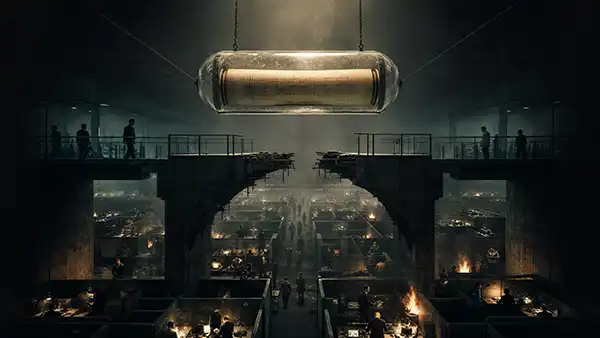
The anthropologist left the organization after three months. The final observation was the simplest. The people who talked about strategy were not the people who did the work. The people who did the work were not consulted about the strategy. The two groups occupied different floors, different calendars, and different realities. The strategy was written in a language the workers did not speak. The work was done in a language the strategists did not understand.
The research on employee voice and organizational learning has documented this divide. A 2025 study published in Journal of Management Studies found that companies in which lower-level employees felt heard outperformed companies in which voice was concentrated among senior leaders. The mechanism was information. The people closest to the work had access to information that the leaders did not have. The hierarchy prevented the information from moving upward. The companies that removed the hierarchy learned faster.
The anthropologist writes this down. The gap between strategy and execution is not a gap between thinking and doing. It is a gap between the people who think and the people who do. The strategy is not failing to execute. The strategy is failing to include the people who know how to execute. The document is not the problem. The distance is the problem.
What the next document could be
The anthropologist does not offer recommendations. The anthropologist offers observations. The observation is that the organizations that close the gap are the ones that treat execution as a design problem rather than a motivation problem. They do not ask people to try harder. They ask what is getting in the way. They do not write longer documents. They write shorter ones with clearer instructions. They do not celebrate the plan. They celebrate the first step.
The research on behavioral activation, developed by Peter Lewinsohn at the University of Oregon, has shown that starting with small, achievable actions is one of the most effective ways to overcome the paralysis that precedes change. The action does not need to be dramatic. It needs to be real. The real action produces evidence. The evidence produces motivation. The motivation produces the next action.
The anthropologist leaves the building. The slide is still on the screen. The applause has faded. The document is in the file. The question is not whether the strategy was good. The question is whether anyone will do anything because of it. The answer, based on the evidence, is probably not. Unless someone decides to start. Unless someone decides to make the first call, schedule the first meeting, write the first if-then plan, measure the first result. The strategy is not the beginning. The first action is the beginning. The first action is available. The first action is now.