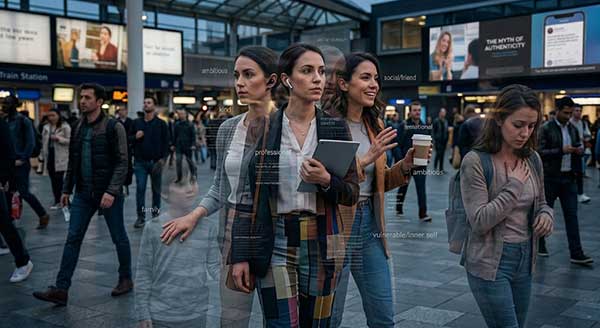
The “Just Be Yourself” Paradox: Why Authenticity Feels Impossible
A friend of mine in Boulder, Colorado once told me that he had spent an entire year trying to “be himself.” He had read the books, listened to the podcasts, even paid for a weekend retreat in the mountains where everyone sat in a circle and talked about their feelings. And after all that, he said, he still did not know what it meant. “I show up to work and I am one person,” he said. “I go home and I am another. I am with my mother and I am a third. Which one is the real me?”
I did not have an answer for him. I still do not. Because the more I think about it, the more I suspect the question itself is built on a false premise. That there is some pure, unchanging self waiting underneath all the social masks, and that if we just tried hard enough, we could peel back the layers and stand naked in front of the world.
The source text I keep returning to this month is about this exact confusion. It asks a question that should stop every reader cold: what does “be yourself” actually mean when the self itself is a construction?
The answer is uncomfortable. The self is not a fixed object. It is a negotiation. And the negotiation never stops.
What We Mean When We Say “Myself”
Here is the problem. The “self” that most of us think of as our true identity is not some inner essence we were born with. It is a pattern of responses, habits, and preferences that formed over years of interaction with other people. The source text is blunt about this: the self is built from external feedback. From approval and disapproval. From the things people praised and the things they punished.
This is not just philosophical speculation. The American sociologist Charles Cooley described this process over a century ago in his 1902 book “Human Nature and the Social Order.” He called it the “looking-glass self” — the idea that we come to see ourselves through the imagined judgments of others. We imagine how we appear to someone else. We imagine their judgment of that appearance. And then we feel something — pride, shame, satisfaction, humiliation — based on what we imagine. The self, in Cooley’s framework, is not discovered in solitude. It is assembled in relation.
This idea is so foundational that it is taught in introductory sociology courses across the United States. And yet we still talk about authenticity as if it meant stripping away the social self to find some pure core underneath. Cooley’s work suggests something different: there is no pure core. There is only a pattern. And the pattern shifts depending on where you are and who you are with. That is not a flaw. That is the design.
Think about it. You were not born knowing that you were funny, or shy, or stubborn, or kind. You learned these things about yourself through the reactions of others. You told a joke and people laughed, so you became the funny one. You cried and someone told you to toughen up, so you learned to hide your tears. The self is not a seed that grows into its predetermined shape. It is more like clay. And other people’s hands have been on it since the day you were born.
The Dinner Party We All Live Inside
The source text uses an example that I have not been able to shake. Imagine you are at a dinner party. You are starving. You want to eat everything on the table. But you do not. Because you know how it would look. Gluttonous. Rude. Selfish. So you hold back. You take a reasonable portion. You chew slowly. You perform the rituals of polite dining.
Now imagine the alternative. You eat everything. You do not care what anyone thinks. What happens? You might be judged in the moment. But if you keep doing it — if you always follow every impulse, every hunger, every unedited desire — you will eventually be excluded. Not because people are cruel. Because every human community depends on some level of restraint. The social contract is not a suggestion. It is a survival mechanism.
This is not an abstract claim. Research on social rejection has shown that exclusion activates the same neural pathways as physical pain. A landmark study published in Science in 2003 by Naomi Eisenberger and her colleagues at UCLA used fMRI scans to show that when people are excluded from a game, their brains respond in ways that overlap significantly with the experience of physical injury. The title of the study says it plainly: “Does Rejection Hurt?” The answer is yes. Social exclusion hurts in the body. That is how deeply wired we are to care about belonging.
The source text says something here that should make us all a little uncomfortable: people who cannot regulate their impulses do not become free spirits. They become isolated. They end up in prisons or institutions or simply alone. The freedom to be “fully yourself” is not freedom at all. It is a fast track to social death.
I remember watching this play out with a guy I knew in college. He prided himself on being brutally honest. No filter. Said whatever came into his head. He called it authenticity. Everyone else called it exhausting. By junior year, he had almost no friends. Not because people could not handle the truth. Because he had mistaken cruelty for honesty and called it being real.
The Masks We Cannot Remove
There is a line in the source text that I have underlined three times: “A certain amount of falseness is compulsory in our relationships with others.” That is not cynicism. It is sociology.
Erving Goffman, one of the most influential sociologists of the twentieth century, wrote a whole book about this. It is called “The Presentation of Self in Everyday Life,” published in 1956, and it remains one of the most cited works in the field. Goffman argued that social life is a kind of theater. We are all performing, all the time. Not because we are liars. Because performance is how social reality gets made. The self, in Goffman’s view, is not something that exists before the performance. The self is the performance.
The source text says we cannot be one hundred percent transparent with each other. We cannot open our full inner world to another person. Not because we are afraid. Because it is impossible. The inner world is too chaotic, too contradictory, too vast to be communicated in full. Language itself is a filter. Every word we choose is a selection. A simplification. A mask.
This sounds bleak. But it is actually freeing. Because if total authenticity is impossible, then we can stop beating ourselves up for failing to achieve it. We can stop chasing the perfect, unfiltered self and start noticing which masks we wear, when we wear them, and whether they are helping or hurting.
What We Can Actually Do
The source text offers something rare in this conversation: not a solution, but a direction. It says we can make small adjustments. We can spend more time with people who let us use fewer filters. We can choose environments where the masks get thinner. We can stop equating politeness with phoniness and start seeing it as a form of care — for ourselves and for others.
The psychologist Carl Rogers, one of the founders of humanistic psychology, wrote extensively about this tension. In his 1961 book “On Becoming a Person,” Rogers argued that psychological health depends on closing the gap between the “real self” and the “ideal self.” But he also acknowledged that complete congruence is an aspiration, not a permanent state. We move toward it. We never fully arrive. The goal is not to be perfectly authentic. The goal is to become more aware of when we are not.
There is a difference between the mask you wear at a job interview and the mask you wear with your oldest friend. The first is heavy. The second is light. The goal is not to remove all masks. The goal is to find the people and places where you can wear the light ones.
The source text uses an image that has stayed with me: if you are a plant in soil where you cannot grow, do not give up on being a plant. Find different soil. The problem is not your nature. The problem is the environment. And sometimes the most authentic thing you can do is leave.
The Small Honest Move
I have started paying attention to the moments when I feel most like myself. Not the dramatic moments. The ordinary ones. The conversation with a friend where I do not have to explain myself. The walk alone where I do not have to perform. The morning coffee before the world wakes up and starts asking things of me. Those are the moments when the gap between who I am and who I appear to be feels smallest.
That is not full authenticity. It is not the raw, unfiltered self I was promised by self-help books. But it is close. Close enough to breathe.
The next time someone tells you to “just be yourself,” maybe the honest response is not to nod along but to ask: which one? The self at work? The self at home? The self that wants to eat the whole dinner table? The self that knows it cannot?
The question is not how to be yourself. The question is how to be a self you can live with. A self that can bend without breaking. A self that can wear its masks lightly and know when to take them off.
That is not the answer I wanted when I first started asking these questions. But it might be the only honest one there is. Not a pure self, waiting to be discovered. A practiced self, built over time, in relation to others, never finished, never fixed.
And maybe that is enough. Maybe that is what being human actually is. Not the removal of all masks. But the knowing of which ones we have on, and the choosing, when we can, to set them down.