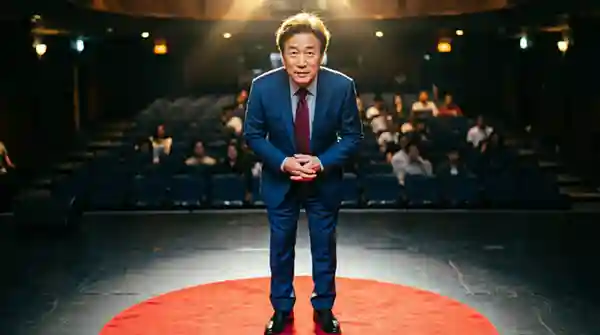
Why Vulnerable Speakers Are More Convincing
The first time I stood on a stage that mattered, I did everything right. I had the slides. I had the data. I had the opening joke and the closing call to action. I had rehearsed in front of a mirror until the mirror was tired of me. And I bombed. Not the kind of bomb that makes a good story later. The kind where people check their phones and you can hear the click of the door when someone leaves.
The paradox is this. The speakers who move us are not the ones who have it all figured out. They are the ones who admit they do not. The most polished delivery in the world cannot compete with a single moment of honest vulnerability. The research says so. The stage says so. And the entrepreneurs who have built the most trusted brands say so.
This is not a feel-good slogan. It is a strategy. And like every strategy, it can be learned.
The Neuroscience of Stage Fright (and Why It’s Not Your Enemy)
Let me start with the uncomfortable part. Your fear is not a flaw. It is a feature.
When you step in front of a room, your amygdala—the brain’s threat-detection system—fires before your conscious mind has time to intervene. The same neural circuitry that kept your ancestors alive when a predator appeared is now interpreting a room full of faces as a potential threat. The result is a cascade of physiological changes: elevated heart rate, shallow breathing, a dry mouth, a narrowing of attention.
A 2024 study in Frontiers in Psychology examined the neural correlates of public speaking anxiety and found that the fear response is not simply a matter of overactive threat detection. It is also a matter of underactive prefrontal regulation. The part of the brain that could calm the amygdala down is, in the moment of performance, offline. The fear is not a choice. It is a system.
But here is where the research gets interesting. The same arousal that feels like terror can be reframed as excitement. A 2023 study in the Journal of Experimental Psychology: General found that participants who were instructed to say “I am excited” before a public speaking task performed significantly better than those who tried to calm down. The arousal was the same. The interpretation was different. The performance followed the interpretation.
The entrepreneurial lesson is direct. You cannot eliminate the fear. You can change what the fear means. The fear is not a signal to stop. It is a signal that something matters.
Why the 18-Minute Rule Is a Neuroscience Principle
TED’s eighteen-minute limit is not an arbitrary constraint. It is a design choice grounded in how attention works.
A 2025 study in Cognitive Research: Principles and Implications examined the sustainability of sustained attention across different presentation formats. The researchers found that cognitive load and attention fatigue follow a predictable curve. Beyond a certain threshold, the audience’s ability to retain information drops precipitously. The threshold varies by content and format, but for narrative-driven presentations, it hovers around the eighteen-to-twenty-minute mark.
The cognitive load theory, developed by John Sweller in the 1980s, explains why. Working memory is finite. A presentation that continues beyond the audience’s capacity to process does not just become less effective. It becomes counterproductive. The audience is not learning more. They are learning less, and they are also learning to associate your message with the feeling of fatigue.
A 2026 study in Frontiers in Communication analyzed the structural features of the most-viewed TED talks. The researchers found that the highest-performing talks were not the longest. They were the most efficient. They used fewer slides, fewer statistics, and more stories. The density of information was lower. The density of meaning was higher.
The entrepreneur’s takeaway is this. The constraint is the gift. When you cannot say everything, you are forced to decide what matters. The discipline of the eighteen-minute limit is the discipline of the founder’s pitch. You have one shot. You cannot waste it.
The Paradox of Vulnerability: Why “Showing the Real You” Works
The second TED principle is the one that makes most entrepreneurs uncomfortable. “Show us the real you. Share your passions, your dreams, your fears. Be vulnerable. Talk about your failures as well as your successes.”
The discomfort is understandable. In business, vulnerability is often framed as weakness. The pitch deck does not have a slide for “my biggest failure.” The investor meeting does not have an agenda item for “what I am afraid of.” The brand narrative is supposed to be a success story, not a confession.
The research says the opposite. A 2024 study in the Journal of Personality and Social Psychology examined the effect of self-disclosure on trust and likability. The researchers found that appropriate vulnerability—sharing a personal struggle, admitting a mistake—significantly increased both. The effect was not about oversharing. It was about authenticity. The audience was not responding to the content of the disclosure. They were responding to the signal that the speaker was not performing.
Brené Brown’s research on vulnerability and shame has become a cultural touchstone for a reason. Her data, drawn from thousands of interviews, showed that the people who were most connected to others were the ones who were willing to be seen in their imperfection. The perfectionism was the armor. The armor was the barrier.
For the entrepreneur, the implication is not that you should stand on stage and cry. It is that you should stop pretending you have never wanted to. The founder who admits that the first version of the product was a disaster is more credible than the founder who claims the path was linear. The leader who says “I was scared” is more trustworthy than the leader who says “I was confident.”
Simplifying Complexity Without Dumbing It Down
The third principle is the one that separates the good speakers from the great ones. “Simplify the complex. Do not confuse with your intellect. Do not speak in abstractions. Give examples. Tell stories. Be specific.”
The temptation for the expert is to demonstrate expertise. The jargon. The acronyms. The nuanced caveats. The intellectual flex. The temptation is understandable. It is also a trap.
A 2025 study in the Journal of Communication examined the relationship between speaker expertise signaling and audience engagement. The researchers found that speakers who used more technical language were perceived as more competent but less trustworthy. The competence was recognized. The trust was not. The audience respected the expertise. They did not connect with the expert.
The narrative transportation theory, first described by Melanie Green and Timothy Brock in 2000, explains why stories work. When an audience is transported into a narrative, their attitudes and beliefs shift in the direction of the story. The shift is not driven by argument. It is driven by immersion. The story does the work that the data cannot.
The entrepreneur’s application is direct. Your product is not a feature list. It is a solution to a problem that a real person is experiencing right now. Tell the story of that person. Name them. Describe their frustration. Show the moment when the frustration ended. The data is the proof. The story is the persuasion.
The Ego Trap: Why Self-Promotion Kills Connection
The fifth principle is the one that entrepreneurs violate most often. “Do not expose your ego. Do not boast. The opposite is the surest way to destroy everyone’s interest and perception of you.”
The research on self-promotion and likability is remarkably consistent. A 2024 study in the Journal of Experimental Social Psychology found that people who talked about themselves excessively were rated as less likable, less competent, and less trustworthy. The effect was not about the content of the self-promotion. It was about the ratio. Too much “I” and not enough “you” signaled narcissism.
The neuroscience of conversation offers a parallel. A 2023 study in PNAS found that talking about oneself activates the same reward circuitry as food and money. The brain likes self-disclosure. But the brain also likes reciprocity. When the self-disclosure is one-sided, the reward becomes aversion.
The entrepreneur who spends the entire pitch talking about the company is not building trust. They are building a monologue. The entrepreneur who asks questions, who listens, who makes the audience the subject of the story, is building a relationship. The relationship is the foundation. The transaction is the byproduct.
When the Rules Do Not Apply (A Note on Mental Health)
I need to be direct about something. The advice in this article is designed for the normal anxiety of public speaking. It is not designed for clinical conditions.
If the fear of speaking is so severe that it interferes with your ability to work, to advance in your career, or to participate in the basic rituals of professional life, that is not a performance problem. That is a health problem. The research on social anxiety disorder and public speaking anxiety is robust. Cognitive behavioral therapy, exposure therapy, and in some cases medication are effective treatments. A therapist can help you distinguish between the nervousness that is normal and the fear that is clinical. That is not weakness. That is wisdom.
The Paradox That Cannot Be Resolved
The TED Talk paradox is not a paradox that can be solved. It can only be practiced.
The most vulnerable speakers are the most convincing. The most disciplined speakers are the most free. The most simplified messages are the most powerful. The most ego-less speakers are the most memorable.
The entrepreneur who understands this does not try to resolve the tension. They live inside it. They prepare relentlessly and then let go. They know the data and then tell the story. They rehearse the structure and then trust the moment. They stand on the stage with their fear and their excitement, their expertise and their uncertainty, their success and their failure. And they speak.
The audience does not remember the slides. They remember the person. The person is the product. The person is the pitch. The person is the point.
The first time I bombed, I thought the problem was the material. The second time, I thought the problem was the audience. The third time, I realized the problem was me. Not because I was bad at speaking. Because I was bad at being seen. The vulnerability was the missing ingredient. The vulnerability was the thing I had been avoiding. The vulnerability was the thing that worked.
The paradox is not a paradox. It is a practice.