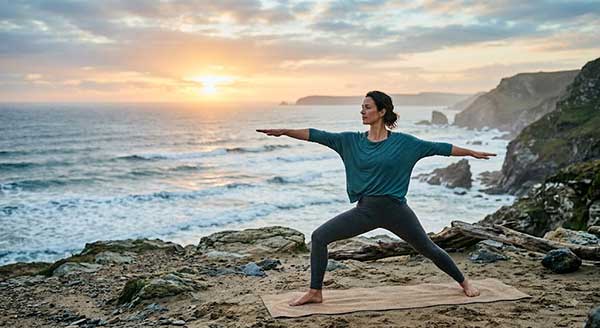
The Rhythm of Return: Why Every Ending Is a Quiet Rebirth
Every yoga flow and every shifting state of body and mind unlocks a different window into ourselves. It often happens in the quiet aftermath of shavasana—that profound pause we translate simply as “corpse pose.” A fellow practitioner, stepping onto the mat for the very first time, turned to me after our final rest and asked a deceptively simple question: “Where do you see yourself five years from now?”
The Illusion of the Five-Year Map
The question caught me entirely off guard. I realized, with a sudden jolt of clarity, that I had never really mapped out the next five years. Truth be told, the next year—sometimes even tomorrow—remained fluid, unscripted. Knowing my winding path through career shifts and sudden life turns, she smiled and said, “When you look at how many times you’ve reinvented yourself, aren’t those sharp bends just mini-deaths and rebirths? You try a road, realize it no longer serves your growth, and you start over, being reborn with a new identity.”
It was a perspective I hadn’t considered quite that way before. Perhaps reincarnation isn’t just an abstract metaphysical concept; perhaps it is simply the rhythm of our lives—the cumulative endings and beginnings through which we continually shed old versions of ourselves and step forward transformed.
The Micro-Cosmology of the Mat
Every challenge we encounter during a physical practice—the wobbles, the muscle fatigue, the moments of resistance, followed by surrender and rest—mirrors the grander arcs of our human journey. The sequence always leads us back to shavasana, that deliberate practice of letting go, followed by the embryonic curl of the fetal position: a literal somatic rebirth.
In psychological and transition theory, human growth relies heavily on our capacity for closure and psychological renewal. As organizational theorist William Bridges notes in his foundational framework on life transitions (Transitions: Making Sense of Life’s Changes), true psychological transformation requires a liminal interval of release—a symbolic ending—before a new identity can take root. When we voluntarily surrender control on the mat, we signal to our nervous system that it is safe to reset.
Ever since I began viewing my practice through this lens, every posture has taken on a richer texture. The mat has ceased to be a place merely to condition the body; it has transformed into an inner laboratory of discovery.
Yielding to the Unfolding River
We talk endlessly about “being in the flow,” a phrase so overused in modern wellness culture that it risks losing its pulse. But when lived deeply, it simply means meeting whatever life hands you without treating time as an adversary. Not every incoming wave is a joyous gift, but our relationship with the wave transforms everything.
Perhaps that is the true secret: abandoning the rigid architecture of five-year plans in favor of cins of the present moment. We do not determine the course of our lives by scheduling every milestone; we shape it through our grace, our resilience, and our willingness to honor the endless, beautiful cycle of birth, release, and rebirth.
May your practice—and your life—find endless room to begin again.
Reference: Bridges, W. (2004). Transitions: Making Sense of Life’s Changes. Da Capo Press.