How Cognitive Biases Quietly Sabotage Your Decisions Without You Noticing
The first time I truly understood how wrong my brain could be, I was standing in my kitchen in Chicago, arguing with my husband about a news story I was certain I remembered correctly. He said the event happened in 2016. I said 2017. I was so sure. The memory was vivid, specific, unshakable. I could see the headline, the room I was in, the particular quality of light that afternoon.
Then he pulled up the article on his phone. The event had happened in 2014. I had been off by three years, and I had been absolutely convinced.
What unnerved me was not the mistake. It was the certainty that had accompanied it. The feeling of being right had been indistinguishable from actually being right. My brain had not just failed. It had failed with confidence.
The psychologist Daniel Kahneman, who won the Nobel Prize in economics for his work on human judgment, called this the most important lesson of his career: the confidence you feel in a belief is not a reliable indicator of its accuracy. In his book “Thinking, Fast and Slow,” he wrote that the brain is not a dispassionate computer weighing evidence. It is a storyteller, and it is constantly telling stories about the world that feel true even when they are not.
That afternoon in the kitchen was my introduction to cognitive bias—a term that sounds academic but describes something we all live with, every day, in ways both small and enormous.
What Is Cognitive Bias and Why Does It Matter
Cognitive bias is a systematic error in thinking. Not a random mistake. A systematic one. A pattern of getting things wrong in predictable ways, built into the architecture of the mind.
The term entered the scientific mainstream in the early 1970s, when the Israeli psychologists Amos Tversky and Daniel Kahneman began publishing their research on how people make decisions under uncertainty. Their work, which later earned Kahneman the Nobel Prize, showed something that challenged the prevailing wisdom of economics and philosophy: human beings are not rational actors. We are not even close.
The brain relies on shortcuts—Tversky and Kahneman called them “heuristics”—to navigate a world that is too complex and too fast to process fully. These shortcuts are not flaws. They are features. They allowed our ancestors to make split-second decisions in dangerous environments, to recognize patterns quickly, to avoid being eaten by predators. Without them, we would be paralyzed by the sheer volume of information we encounter every moment.
But the shortcuts come at a cost. They distort. They oversimplify. They fill in gaps with assumptions. And because they operate below the level of conscious awareness, we rarely notice when they are leading us astray.
The poet Emily Dickinson wrote that “the brain is wider than the sky,” and she was right in ways she could not have known. The brain is vast, but it is also lazy. It reaches for the nearest answer, the familiar pattern, the comfortable story. The reaching is not a moral failing. It is biology.
Why Your Brain Refuses to See Its Own Mistakes
Here is the most uncomfortable part of all of this. The bias is not something that happens to other people. It is not a defect of the uneducated or the irrational. It is universal.
I have a friend, a brilliant neurosurgeon in Minneapolis, who falls for the same cognitive traps as everyone else. He is better at his job because of his training, not because his brain is fundamentally different. He still overestimates his knowledge on topics outside his specialty. He still remembers his own successes more clearly than his failures. He still, like all of us, trusts a confident face more than a nervous one.
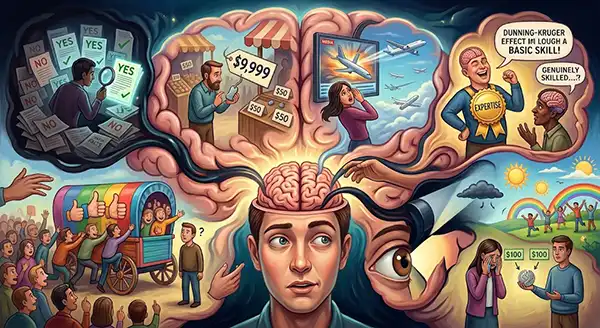
The psychologist David Dunning, at the University of Michigan, has spent his career studying what happens when the brain cannot see its own limitations. His work, conducted with Justin Kruger and published in 1999, identified a pattern now known as the Dunning-Kruger effect: people with the least knowledge in a given area often have the most confidence in their abilities. Not because they are arrogant. Because they lack the very expertise needed to recognize their own incompetence.
What makes this so difficult to address is that the error is invisible from the inside. The person who is wrong does not feel wrong. They feel exactly as certain as the person who is right. The feeling of certainty is not evidence. It is just a feeling.
I have started to notice this in myself. The more certain I feel about something, the more suspicious I try to be. Not because I am insecure. Because the research is clear: certainty and accuracy are only loosely related. The strongest beliefs are often the least examined.
The Mental Shortcuts That Shape Your Day
The heuristics Tversky and Kahneman identified come in several flavors, and they all share a common structure. The brain takes a small piece of information and uses it to build a large, confident conclusion.
The availability heuristic is one of the most common. When you judge how likely something is, you tend to rely on how easily examples come to mind. Shark attacks feel common because they are dramatic and memorable, even though you are far more likely to be injured by a falling coconut. Plane crashes terrify us more than car crashes because plane crashes make the news, even though driving is statistically far more dangerous. The ease with which you can call up a memory is not the same as the frequency of the event. But the brain treats it that way.
The representative heuristic is subtler. You form a mental prototype of a category, and then you judge new examples by how closely they match the prototype. A person who looks like your idea of a librarian is assumed to be quiet and bookish, even if they are actually a sales executive. The prototype overrides the evidence.
There is also the anchoring heuristic, in which the first piece of information you encounter shapes everything that follows. If you are told a car costs $40,000, the $35,000 price tag afterward feels like a bargain, even if the car is worth only $20,000. The initial number sets the frame, and the frame is hard to escape.
None of these are signs of stupidity. They are signs of a brain that is trying to be efficient. The problem is that efficiency and accuracy are not the same thing, and we keep paying the price for the difference.
The Biases You Have Almost Certainly Fallen For
Beyond the basic heuristics are the specific biases that have been named and studied over the decades. They are not rare. They are the water we swim in.
Confirmation bias is probably the most famous. You seek out information that supports what you already believe and ignore or discount information that contradicts it. You remember the times your intuition was right and forget the times it was wrong. You surround yourself with people who agree with you and call it community. The result is a world that feels coherent and true and is actually a carefully edited version of reality.
The psychologist Thomas Gilovich, at Cornell University, has documented this extensively. In his book “How We Know What Isn’t So,” he showed that people do not approach evidence as neutral observers. They approach it as lawyers, building a case for what they already believe. The evidence is not the foundation of the belief. The belief is the filter through which the evidence is seen.
Optimism bias is another one. You believe that bad things are less likely to happen to you than to other people. You know the statistics on divorce, on heart disease, on car accidents—but those are other people’s problems. The optimism is not all bad. It keeps us going when things are hard. But it also leads us to skip the seatbelt, skip the checkup, skip the savings account. The belief that everything will work out is comforting, but it is not a plan.
Then there is the halo effect, which I have written about before. You meet someone attractive, and you assume they are also smart, kind, and trustworthy. The face is not the person, but the brain treats it that way. The psychologist Edward Thorndike identified this bias over a century ago, and it has not weakened since. In studies, attractive defendants receive lighter sentences. Attractive students receive higher grades. Attractive candidates receive more job offers. The halo is not a metaphor. It is a force.
What You Can Actually Do About It
Here is the part I find most hopeful. The biases are real, but they are not destiny. The research suggests that simply knowing about them helps. A study published in the journal Psychological Science found that awareness of cognitive bias can reduce its influence, though it does not eliminate it. The awareness is the beginning.
There are practices that help. Not perfect solutions, but better habits.
The first is to slow down. Most cognitive biases operate automatically, in the fast, reflexive part of the mind. When you are making a decision that matters—a financial decision, a relationship decision, a decision about your health—do not rush. The extra time does not guarantee a better answer, but it gives the slower, more deliberate part of your brain a chance to catch up.
The second is to seek out disconfirming evidence. Ask yourself: What would have to be true for me to be wrong? What am I not seeing? Who disagrees with me, and why might they have a point? The questions are uncomfortable. They are supposed to be.
The third is to keep a decision journal. Write down what you decide, why you decided it, and what you expect to happen. Then go back and check. The journal will reveal your patterns. The prediction you were sure about that did not come true. The fear that proved unfounded. The confidence that was misplaced. The record does not lie, even when your memory does.
The philosopher and psychologist William James once said that a great many people think they are thinking when they are merely rearranging their prejudices. That line has followed me for years. It is both a warning and an invitation. The warning is that most of what passes for thought is just bias in a nicer outfit. The invitation is that real thinking is possible, if you are willing to do the work.
The work is not glamorous. It is not the stuff of motivational posters. It is the quiet, daily practice of questioning yourself, of checking your assumptions, of being willing to say the sentence that is hardest to say: “I was wrong.”
That sentence, in my experience, is the gateway to everything. It is the difference between a mind that is closed and a mind that is still learning. It is the difference between certainty and wisdom.
I do not know which of my beliefs is wrong. I cannot know. The very nature of bias is that it hides from the person who has it. But I can stop treating my certainty as evidence. I can stop confusing confidence with accuracy. I can hold my beliefs a little more lightly, with a little more humor, a little more willingness to be surprised.
The world is bigger and stranger and more complicated than any of us can hold. That is not a problem to be solved. That is the condition of being alive.
And the only response that makes any sense is to stay curious, stay humble, and keep asking the question that the bias does not want you to ask: What am I missing?
The question does not always produce an answer. But it produces something better. It produces a mind that is still open. A mind that is still learning. A mind that has not yet been entirely captured by the stories it tells itself.
That, I think, is the whole work. Not the elimination of bias—that is impossible. The recognition of it. The willingness to be wrong. The slow, unglamorous practice of thinking more carefully, not because you are smarter than other people, but because you know you are not.
A Few Things Worth Asking Yourself
How do I know when I am being biased?
You do not always know. The bias operates invisibly. But there are signals. When you feel certainty about something you have not examined closely, that is a signal. When you avoid people who disagree with you, that is a signal. When you cannot explain the other side’s argument in a way they would accept, that is a signal. The signals are not proof of bias. They are invitations to look more closely.
Is it possible to eliminate cognitive bias entirely?
No. The biases are built into the structure of the brain. They are not bugs. They are features, shaped by evolution to keep us alive in a dangerous world. The goal is not to eliminate them. The goal is to recognize them, to account for them, to reduce the harm they cause. That is enough. That is the work.
What is the most important cognitive bias to watch out for?
Confirmation bias is the one that causes the most damage, because it affects everything else. It determines what information you seek out, what evidence you accept, what conclusions you reach. If you can learn to notice when you are looking for confirmation instead of truth, you have made a real start.
Where This Leaves Me
I still argue with my husband about things I am certain about. I still catch myself falling for the halo effect, the optimism bias, the anchor. The difference now is that I catch it faster. And when I catch it, I try to do something different. I try to pause. I try to ask the question. I try, even if only for a moment, to consider the possibility that I am wrong.
That small act—the willingness to be wrong—has changed more in my life than almost anything else. It has made my conversations richer, my decisions slower and better, my relationships more honest. It has not made me smarter. It has made me less dangerous.
The brain is not a supercomputer. It is a storyteller, and the stories it tells are often beautiful and often wrong. The beauty does not cancel the wrongness, and the wrongness does not cancel the beauty. They coexist, like everything else.
The only question is whether you will be honest enough to see both.
I am trying. Not because I am enlightened. Because I am tired of being fooled by my own certainties. Because the world is too interesting to see it only through the narrow window of what I already believe.
The window is there. It is always there. But it is not the whole view. The view is wider, stranger, more alive than any single story can hold.
And the only way to see more of it is to open the window a little wider, and to admit, with as much grace as you can manage, that you do not know nearly as much as you think you do.
That is the beginning. That is the whole thing. The admission is the opening.
And the opening is where the light gets in.