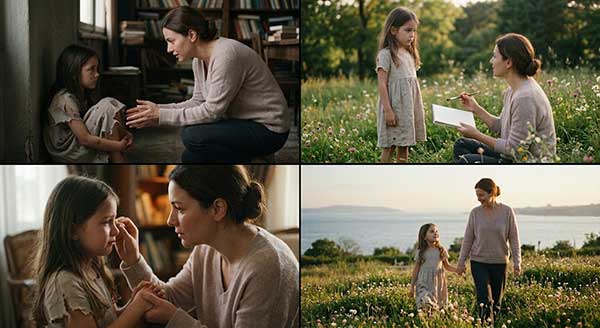
Time to Ask the Child Inside: What Was Your Trouble
There is a corner of every house that belongs to grief. Not the living room where guests sit, not the kitchen where small talk happens. A corner. Somewhere with a wall close enough to lean on, where the light does not insist on itself. That is where the body goes when it needs to cry in a way no one taught it to.
I found my corner once in a rental apartment in Chicago, the winter my father stopped answering the phone. I sat on the floor with my back against the radiator and cried until the heat came on and I had to move. By then something had shifted. Not the situation. The situation was the same. But I had stopped performing the grief and started living inside it. That is what this text is about.
The deepest human dilemma here is not sadness. It is the moment when you stop crying about the story of your life and start crying for the child who lived it before the story hardened into fact. The moment the tears stop being about what happened and become a doorway back to the one it happened to.
The Ocean We Carry
The text begins with a kind of permission: “Leave me here, I will keep crying.” Not as a threat. As a task. The speaker has oceans tied to their heart, and those oceans need to empty. Every heart-twist raises the water. Every sob lowers it, just slightly. This is not self-pity. This is drainage.
I have felt that rising. The way grief collects in the body, not as emotion but as weight. The chest full of sea. The throat that cannot swallow it back down. Crying becomes the only honest plumbing. And the text insists on crying slowly, deliberately, with enjoyment — “keyfini çıkara çıkara” — savoring the cry. That phrase stopped me. Because most of us cry the way we do everything else: quickly, apologetically, with an eye on the clock. The text proposes something else. A final, luxurious, complete emptying.
What is being emptied? The oceans left by everyone who failed to love properly. The mother who would not take her along. The father who looked through her. The sibling who did not count her as kin. The friends who cut from behind. The lover who never made room in his heart. And beneath all that, the speaker’s own curse — the self-blame that turns every wound into a verdict.
This is the inventory of a lifetime spent learning that love must be earned. And the crying is not about the losses. It is about the belief system built on top of them.
The Birth of the Old Childhood
Then comes the strangest and most powerful image in the text: “I will not give birth to a child, I will give birth to my discarded childhood through my eyes.”
Read that again. The speaker is not crying tears. She is in labor. The groans, the pushing, the ıkınarak — the Turkish word for bearing down — all midwifery. What emerges is not a baby but the childhood that was never allowed to exist. The child she was before she learned to perform for love, to shrink for safety, to hate herself for needing.
This is not regression. It is retrieval. The adult woman sits on the floor and births the child she buried. Not to become that child again, but to finally meet her.
I have watched people do this in therapy. The moment does not look like a breakthrough. It looks like a collapse that turns, halfway through, into a conversation. The voice changes. The face softens. The person starts speaking about herself in the second person — not as a symptom, but as a presence. “You were so scared,” she says to no one in the room. But someone is listening.
The Tunnel Through the Eyes
After the emptying comes the turning. The speaker, doubled over, straightens. Her stomach is clean. And her eyes — those eyes that have been pouring out oceans — have become a tunnel. A bright corridor leading back through time. She looks through them, and she sees the child.
“Now speak: What was your trouble?”
This is the question the entire text builds toward. Not “Why did this happen to you?” Not “Who hurt you?” But “What was your trouble?” Derdin neydi? It is a question that does not assume. It does not diagnose. It asks the child to speak from her own experience, in her own words, without the adult translating or correcting.
The speaker says something crucial: “From my own broken places, I could not hear you.” This is the tragedy of unhealed trauma. The wounded adult cannot listen to the wounded child because they are both speaking at the same time. The crying is what clears the channel. Only after the oceans are emptied can the listening begin.
And then the promises. “I am here, beyond past, future, and time. You speak, I listen. Without reason, without conclusion, I watch.” This is not a rescue. It is a witnessing. The child does not need to be saved. She needs to be seen.
The Collapse of the Fortress
There is a line that should stop every reader cold: “The world I built as a fortress around myself has collapsed.”
This is not a defeat. It is a demolition. The fortress was built from the same material as the ocean — the defenses, the narratives, the careful explanations, the identities constructed to survive. When the crying ends, the fortress comes down with it. And in the rubble, two figures remain: the adult and the child, facing each other on a desert planet.
“On the desolate planet Earth, two pure children looking at each other.”
The word “pure” here does not mean innocent. It means unburdened. The child is pure because she has not yet been told what she should be. The adult becomes pure again by emptying everything she was told to carry. They are not bound to any sea. They are the sea itself.
This is the moment Jung would call integration. Not the elimination of the child, not the worship of the child, but the meeting. The adult who can finally sit with the child and ask, with genuine curiosity, “What was it like for you?” has done something most people never do. She has stopped being the child’s guardian and become her witness.
The Watching, Not the Waiting
The text makes a careful distinction: “This is not waiting. This is watching.”
Waiting implies expectation — a future moment when something will happen. Watching implies presence — a current moment where something is already happening. The speaker is not waiting for the child to emerge. She is watching the child emerge, right now, in real time.
She watches the past dissolve from the child’s eyes. She watches the child walk toward her from those distant lands. She watches existence appear in the child’s gaze, fear fall away, presence arrive without challenge. She watches being.
And then the welcome: “Welcome, child. Once more, welcome. To the now, to the closing of all times and the writing of the new. To what is independent from everything — from pasts, from knowns, from what has been said. To the unknown and the unknowable.”
This is not a happy ending. It is a beginning that refuses to pretend. The child is welcomed into a present that has no furniture yet. No stories, no explanations, no identities. Just two beings facing each other, full to the brim, ready to listen.
I think about my own corner in that Chicago apartment. The radiator clicked on. I moved because I had to. But before I did, I asked — not in words, not out loud — “What was your trouble?” And something very small, very old, very tired, looked up at me and said, “You never asked before.”
That was the moment the fortress cracked.
One Thing Before You Go
Tonight, find your corner. Do not bring a journal. Do not bring a plan. Just sit and let the first tears come if they come. When they slow, straighten your spine and imagine a tunnel opening behind your eyes. Ask the question: “What was your trouble?” Then do not answer. Watch. The child will speak when she trusts you. The watching is the welcome.
Three Questions I Keep Getting
How do you know the difference between healthy crying and re-traumatizing yourself?
Healthy crying has a bottom. It ends, even if it takes hours. Re-traumatization does not resolve — it repeats the same loop with the same intensity. The key is the question afterward. If you can turn toward the child with curiosity, you are emptying. If you only feel worse and more collapsed, pause and seek support.
What if I cannot find a specific childhood memory to connect to?
You do not need one. The child is not a memory. The child is a presence that exists in your body right now. Start by asking the question without expecting a visual image. Some people experience the child as a sensation, a temperature, a tightening in the chest, or a sudden tiredness. That counts.
Do I have to do this alone?
No. The text is written as a soliloquy, but the work can be done with a therapist, a trusted witness, or even in writing — a dialogue between the adult self and the child self. The essential thing is that someone finally asks the question without assuming the answer.