What It Really Means to Know Yourself: Why No One Else Can Do This Work for You
I was thirty-four years old, sitting on a wooden bench at a silent meditation retreat in rural Vermont, when I realized I had no idea who I was. Not in the dramatic, movie-moment way. In the quiet, uncomfortable way. The retreat required no talking, no reading, no phones. For the first time in years, the external noise had been stripped away. And underneath all that noise, I did not find a self. I found a stranger.
I had spent years learning other people. I could tell you my wife’s anxieties before she voiced them. I could read a room, sense a mood shift, predict a friend’s reaction. I thought that made me emotionally intelligent. But when the room went silent and there was no one left to read, I discovered I had never learned the most basic skill of all: knowing what was happening inside my own chest.
The psychiatrist Carl Jung wrote that the cure for our soul-sick civilization is a serious investment in the inner world. He wrote that in the 1960s, long before smartphones and social media and the particular exhaustion of modern life. But the diagnosis has only become more true. We are a culture of external focus. We know the lives of strangers in detail. We know our friends’ schedules, our coworkers’ moods, our partners’ needs. What we do not know, most of us, is the landscape of our own inner lives.
That retreat in Vermont was the beginning of a long, unglamorous education. Not in a seminar hall. Not through a book. Through the daily, repetitive, often boring work of turning inward and asking: Who is actually here?
Why We Think We Know Ourselves When We Do Not
The first illusion is the easiest to fall for. We mistake the story we tell about ourselves for the self. We say, “I am the kind of person who…” and then we fill in the blank with something we inherited. I am the reliable one. I am the funny one. I am the one who never cries. These stories feel true. They have been repeated for so long they have worn grooves in our minds.
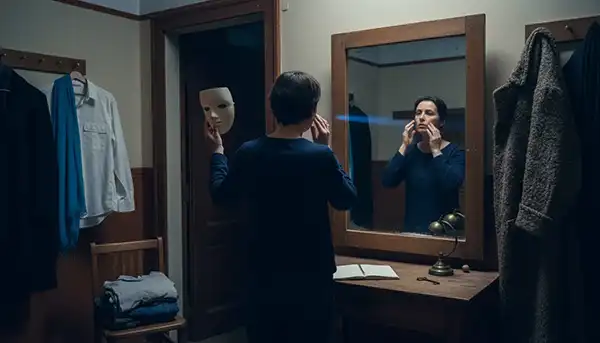
But the stories are not the self. They are a mask. And the mask is often created early, in childhood, when we learned which parts of us were acceptable and which parts needed to be hidden.
The psychologist Karen Horney, one of the first women to make major contributions to psychoanalysis, wrote about this in the 1940s. She argued that we develop an “idealized self”—a version of ourselves that is stronger, smarter, more lovable than the real thing. We spend our lives trying to become this idealized image, and in the process, we lose touch with who we actually are. The gap between the real self and the idealized self becomes a source of constant, low-grade suffering.
I know that gap intimately. For years, I wore the mask of the easygoing friend, the one who never got angry, never made demands, never needed anything. It was a good mask. People liked it. I liked it. But underneath, the real me was furious. The real me was exhausted. The real me was starving for something I could not name.
The mask was not a lie, exactly. It was a survival strategy. But survival strategies have a shelf life, and mine had expired.
The Uncomfortable Truth About Taking Responsibility
Here is the part that took me years to accept: no one is coming to save me. Not a therapist. Not a partner. Not a self-help book. The responsibility for knowing myself—for actually doing the work, not just reading about it—belongs to me alone.
This is not a popular message. We want the shortcut. We want the seminar that will change everything, the book that will unlock the hidden self, the therapist who will hand us the map. And those things can help. The map is real. The guidance is real. But the walking is mine.
The psychologist Albert Ellis, founder of Rational Emotive Behavior Therapy, was blunt about this. He used to tell his clients that insight alone changes nothing. You can understand exactly why you are the way you are, trace every pattern back to its childhood origin, and still be stuck. The change comes not from understanding but from doing. From practicing new ways of being, day after day, until they become as automatic as the old ones.
That was the hardest part for me. I wanted the insight to be enough. I wanted the moment of clarity in my therapist’s office to last. It did not. The clarity faded, and I was left with the daily grind of trying to live differently.
What the Work Actually Looks Like
The work is not glamorous. It does not happen in a single dramatic breakthrough. It happens in the small, repeated choices that make up a life.
It looks like pausing before I say yes, to check whether I actually mean it. It looks like noticing the anger rising in my chest and not immediately pushing it down. It looks like sitting with the discomfort of not knowing, instead of reaching for the nearest distraction.
It looks like failure, most of the time. I fall back into the old patterns. The mask goes back on. The autopilot takes over. And then, somewhere in the middle of a Tuesday afternoon, I notice. And the noticing is the practice. The noticing is the whole practice.
The teacher and author Tara Brach calls this “radical acceptance.” It is the willingness to be with what is, exactly as it is, without trying to fix it or escape it. In the context of self-discovery, it means accepting what you find when you look inside—the fear, the anger, the neediness, the mess—without turning away.
That was the thing I had been running from for years. Not the hard work. The honest looking. The willingness to see myself clearly, flaws and all, without flinching.
What You Find When You Stop Running
When I finally stopped running, I did not find a monster. I did not find some dark, unlovable core that needed to be fixed. I found something smaller and stranger: a person. Just a person, with needs and fears and desires that had been buried for so long they had gone quiet.
The quiet needs were the saddest part. The need to rest. The need to say no. The need to be seen without performing. They had been there the whole time, whispering under the noise of the mask. I had been too busy being the easygoing friend to hear them.
The writer and researcher Brené Brown, at the University of Houston, has spent decades studying what happens when people stop performing and start being honest. Her research shows that the willingness to be seen—really seen, in all our messy humanity—is not a weakness. It is the foundation of every meaningful connection. The mask does not protect us. It isolates us.
I have felt that isolation. The loneliness of being surrounded by people who know the mask but not the person behind it. The exhaustion of maintaining a performance that never ends. The quiet grief of realizing that I had been hiding for so long that even I did not know who I was anymore.
The unmasking was not a single event. It was a slow, stumbling process. It happened in my therapist’s office. It happened in conversations with my wife, when I said the true thing instead of the pleasant thing. It happened in the middle of the night, lying awake, when I let myself feel the feelings I had been avoiding for years.
A Different Kind of Journey
I want to be honest about the limits of what I can offer here. This is not a map. It is not a method. It is a story, and stories can only do so much.
The map that matters—the one you actually need—can only be drawn by you. It is drawn in the small choices you make every day, in the moments when you turn toward yourself instead of away. It is drawn in the therapy sessions, the journal entries, the difficult conversations, the quiet minutes of honest self-reflection.
If you are ready to begin that journey, there is help available. A therapist can guide you, not by telling you who you are, but by asking the questions that help you discover it. The American Psychological Association can help you find a qualified provider. The National Alliance on Mental Illness offers resources for those who are struggling.
And if the journey feels too heavy right now—if the inner world is a dark and frightening place, if the sadness has been there for so long it feels like part of you—please reach out. The Suicide and Crisis Lifeline is available by calling or texting 988. You do not have to do this alone.
The journey into the inner world is not always safe to take alone. Sometimes it requires a companion. Sometimes it requires a guide. And there is no shame in needing either.
What I Know Now
I am not finished. I do not think I ever will be. The self is not a destination. It is a relationship, and like any relationship, it requires tending.
The other morning, I sat in my living room with a cup of coffee and did not check my phone. I just sat there, in the quiet, and asked myself the question I had been avoiding for years: How are you, actually?
The answer was not dramatic. It was just true. A little tired. A little sad. A little hopeful. A little scared.
And for the first time in a long time, I did not try to change it. I just let it be there. The tiredness and the sadness and the hope and the fear, all of it, in one room, in one body, in one ordinary moment.
That is what it means to know yourself, I think. Not to fix anything. Not to become anything. Just to be honest about what is already there.
The mask is not evil. It was never evil. It was just a way of surviving a world that felt unsafe. But survival is not the same as living.
The living, it turns out, requires a different kind of courage. The courage to be seen. The courage to be flawed. The courage to be human.
That courage is not something you find once and keep forever. It is something you practice, day by day, in the small moments when you choose honesty over performance.
The next time you catch yourself performing—the smile you do not mean, the yes you do not want to give, the “I’m fine” that is anything but—pause. Ask yourself: What is true right now? Not the pleasant version. The true one.
The answer may be uncomfortable. It may be messy. It may not fit the story you have been telling about who you are.
But it will be yours.
And that, in the end, is the whole journey. Not the becoming. The remembering. The slow, unglamorous work of coming home to yourself.
The world is full of people who live their whole lives in the mask, never knowing the face underneath. Do not be one of them.
The face is still there, waiting. It has been waiting a long time.
And it is beautiful, in ways you have not yet begun to imagine.